You’ve probably had a foot massage at a spa, or maybe someone rubbed your feet after a long day. But have you ever wondered where this simple act came from? It’s not just a modern luxury-it’s a practice older than pyramids, woven into the daily life of ancient civilizations across continents. From sacred temple rituals to street-side healing in bustling Asian markets, foot massage has been a quiet hero of wellness for thousands of years. And it’s still alive today, not as a fad, but as a deeply rooted cultural tradition.
Foot Massage Isn’t Just Relaxation-It’s Ancient Medicine
Think of your feet as a map of your body. In traditional Chinese medicine, over 60 acupuncture points live on the soles, each linked to organs, nerves, and systems. Pressing these points isn’t random-it’s a deliberate way to restore balance. This idea didn’t start in a 21st-century spa. It was documented in the Huangdi Neijing, a Chinese medical text from over 2,500 years ago. That’s older than the Roman Empire. Foot massage wasn’t a treat back then-it was a medical tool, used to treat digestive issues, headaches, and even insomnia.
In India, Ayurveda treated the feet as the foundation of health. The Charaka Samhita, written around 1500 BCE, describes oil massages for the feet to improve circulation and calm the nervous system. Ayurvedic practitioners believed that toxins collected in the feet over time, and daily self-massage with warm sesame or coconut oil was essential to flush them out. This wasn’t optional self-care-it was part of daily hygiene, like brushing your teeth.
How Ancient Egypt Used Foot Massage to Honor the Dead
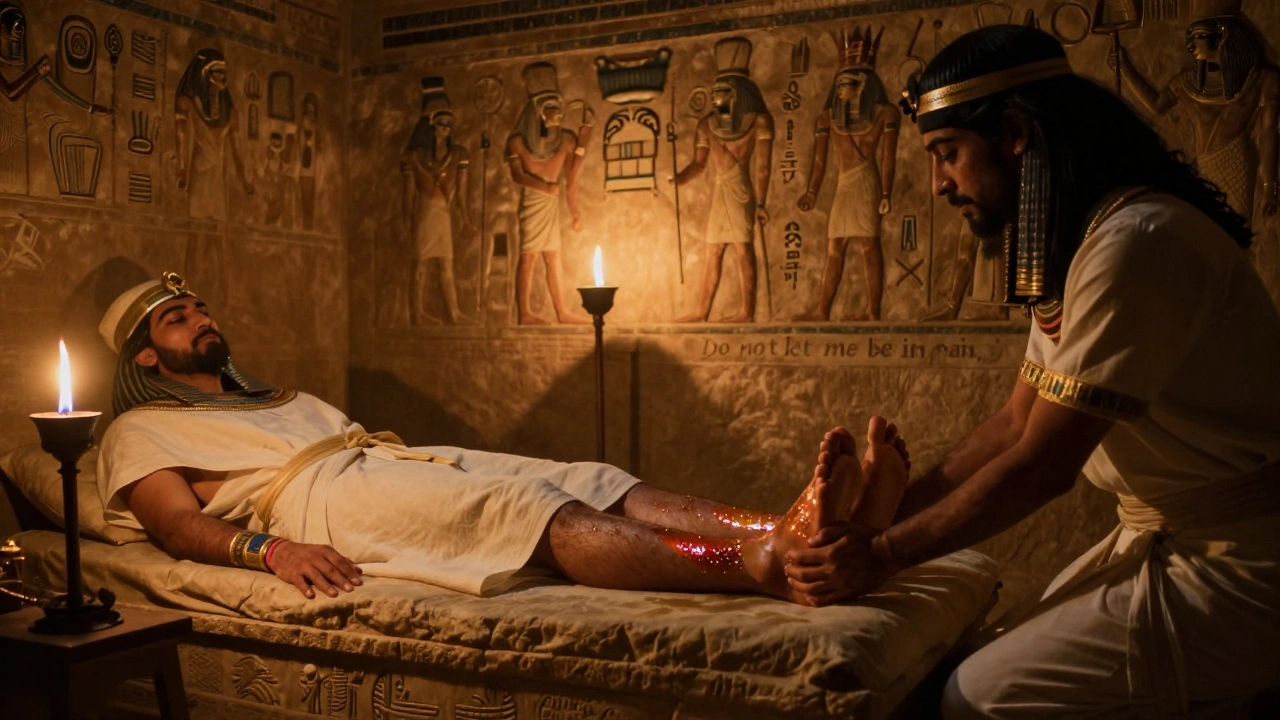
Walk into any Egyptian museum, and you’ll see carvings on tomb walls showing servants massaging the feet of nobles. One of the most famous is in the tomb of Ankmahor, a high priest from around 2330 BCE. The image shows two men holding the feet of a nobleman while another applies pressure to his soles. The caption reads: “Do not let me be in pain.”
This wasn’t just about comfort. In Egyptian belief, the feet were the last point of contact with the earth-and the first point of connection to the afterlife. Massaging them was thought to ease the soul’s journey. They used oils infused with myrrh and frankincense, both expensive and sacred. These weren’t just scents-they were spiritual tools. The practice was so respected that foot massage was reserved for the elite, priests, and pharaohs. Common people? They probably rubbed their own feet with sand and water after a long day walking barefoot on hot stone.
Japan’s Amma: The Birth of Reflexology
Foot massage traveled east and evolved. In Japan, it became Amma-a form of bodywork that combined pressure, stretching, and acupressure. Amma practitioners didn’t just focus on the feet; they worked the entire body, but the feet were always the starting point. Why? Because they believed energy, or ki, flowed through channels that began at the soles.
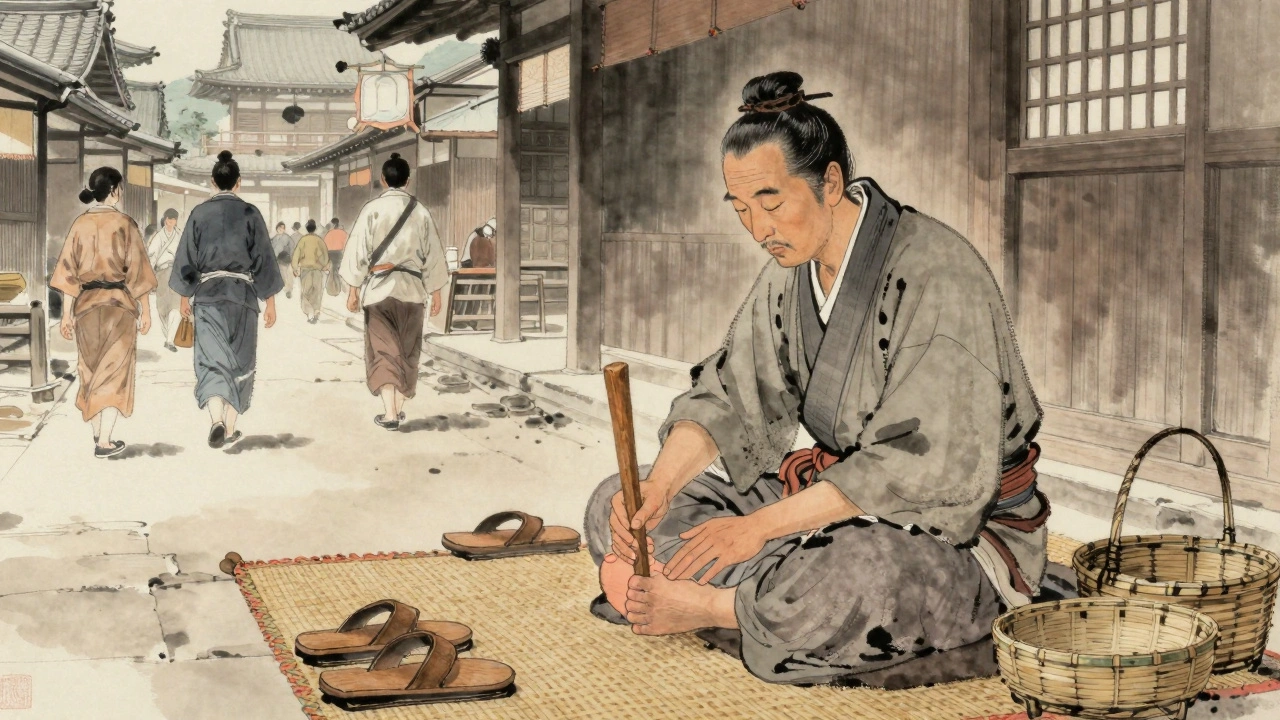
By the 17th century, Amma was so common that it became a street-side profession. You’d find Amma masters sitting on mats outside temples, offering quick sessions to merchants, samurai, and travelers. They used their thumbs, knuckles, and even wooden sticks to apply pressure. No oils, no music, no candles-just direct, firm pressure to release tension and restore energy flow.
Modern reflexology, which maps specific zones on the feet to organs, comes directly from this tradition. In the 1910s, American physician William Fitzgerald brought Amma principles to the West and called it “zone therapy.” He didn’t invent it-he just gave it a new name and a scientific label.
China’s Healing Hands: From Emperors to Modern Clinics
China didn’t just write about foot massage-it perfected it. During the Tang Dynasty (618-907 CE), imperial courts had royal foot therapists. These weren’t just masseurs-they were trained healers who studied pulse reading, herbal remedies, and meridian theory. They massaged the emperor’s feet daily, not just for comfort, but to prevent illness.
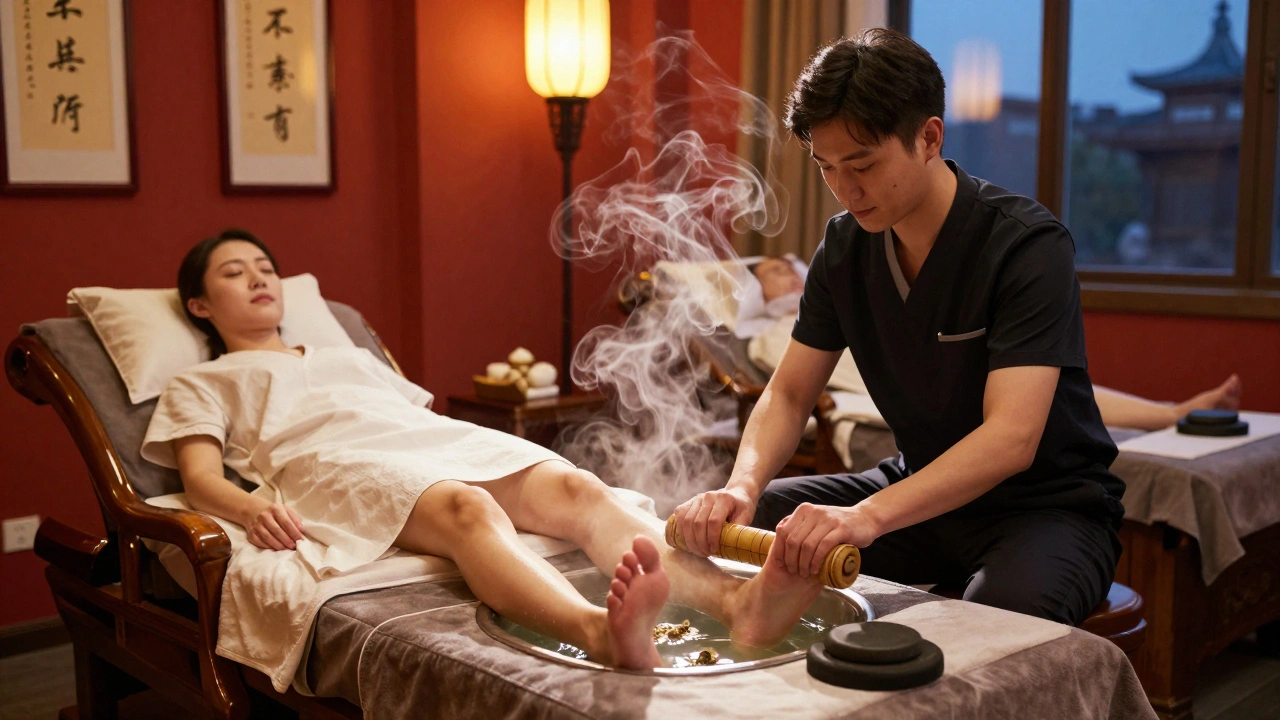
Today, you can still find foot massage halls in every Chinese city. In Shanghai, people line up for hours at places like Zu Li Zhen, where sessions last up to two hours. They use wooden rollers, bamboo sticks, and heated stones. The goal? Not just to relax, but to stimulate blood flow, reduce swelling, and improve digestion. Many clinics even offer herbal foot soaks before the massage, using ingredients like ginger, mugwort, and salt-each chosen for its healing properties.
And it’s not just for older people. Young professionals in Beijing and Guangzhou use foot massage as a way to recover from long workdays. It’s as normal as drinking tea.
Native American and African Traditions: Grounding Through Touch
Across the Atlantic, foot massage was part of spiritual and physical healing too. Among the Navajo, elders used foot rubbing as part of healing ceremonies. They believed the feet carried the weight of the day’s worries and that massaging them helped release negative energy. They often combined it with chanting and sacred herbs like sage.
In West Africa, especially among the Yoruba people, foot massage was used to prepare children for growth and to help the elderly stay mobile. Herbal poultices made from crushed leaves and oils were applied before rubbing. The rhythm of the massage was slow and rhythmic, almost like a lullaby. It wasn’t just about the body-it was about connecting with ancestors and the earth.
These traditions didn’t fade. In rural villages across Nigeria and Ghana, foot massage is still passed down from grandmother to granddaughter. No spa needed. Just a mat, warm oil, and hands that know how to listen.
Why Foot Massage Spread Across Cultures-And Why It Still Works
Why did so many cultures, thousands of miles apart, all land on the same idea? Because feet are hardworking. They carry us. They take hits-on pavement, sand, snow, stone. They’re full of nerves, blood vessels, and pressure points. And they’re always the last part of the body to get attention.
Modern science backs this up. A 2020 study from the Journal of Alternative and Complementary Medicine found that foot massage significantly reduced stress hormones in hospital patients. Another trial showed improved sleep quality in people with chronic insomnia after just two weeks of nightly foot rubs.
But it’s not just about biology. It’s about ritual. Rubbing someone’s feet is one of the most intimate, non-sexual acts of care. It says: “I see you. I’m here with you.” That’s why it survived wars, colonization, and modernization. It’s not a trend. It’s a human need.
What Foot Massage Looks Like Today-From Tokyo to Toronto
Today, you can get a foot massage anywhere. In Tokyo, there are robot foot massagers in train stations. In Bangkok, street vendors offer 15-minute sessions for under $3. In New York, luxury spas charge $120 for an hour with heated stones and essential oils.
But the core hasn’t changed. Whether it’s a grandmother in rural India using coconut oil, a reflexologist in London pressing points linked to the liver, or a teenager in Los Angeles using a foam roller after a workout-they’re all doing the same thing. They’re honoring the feet as the body’s foundation.
The real difference? Now we know why it works. And we have more tools to do it right.
How to Try Foot Massage at Home-The Simple Way
You don’t need a spa to benefit. Here’s how to do it yourself:
- Soak your feet in warm water with Epsom salt for 10 minutes. This softens skin and relaxes muscles.
- Dry them, then apply a little oil-coconut, almond, or even olive oil works.
- Use your thumbs to press along the arch, starting from the heel and moving to the ball of the foot. Hold each point for 5 seconds.
- Roll a tennis ball under your foot for 2 minutes. It’s like a mini massage.
- Finish by gently pulling each toe, one at a time.
Do this for 10 minutes before bed. You’ll sleep deeper. Your legs will feel lighter. And you’ll be doing something people have done for over 5,000 years.
Foot Massage vs. Other Body Massages: What Makes It Unique
| Feature | Foot Massage | Swedish Massage | Deep Tissue Massage |
|---|---|---|---|
| Primary Focus | Soles, arches, toes, reflex zones | Full body, relaxation | Deep muscle layers, chronic tension |
| Time Required | 15-60 minutes | 60-90 minutes | 60-90 minutes |
| Frequency | Daily or weekly | Monthly | Bi-weekly or as needed |
| Cost (Average) | $15-$80 | $60-$120 | $70-$130 |
| Best For | Stress relief, sleep, circulation | General relaxation | Chronic pain, injury recovery |
| Cultural Roots | China, India, Egypt, Japan | Europe, 18th century | Modern Western therapy |
Foot massage is cheaper, faster, and easier to do at home. You don’t need to undress. You don’t need a professional. You just need your hands and five minutes.
Frequently Asked Questions
Is foot massage safe for everyone?
Most people can safely enjoy foot massage. But avoid it if you have open sores, blood clots, severe diabetes with nerve damage, or are in the first trimester of pregnancy. Always check with your doctor if you have a chronic condition.
Can foot massage really help with headaches?
Yes. According to traditional Chinese medicine, pressing the big toe stimulates the head and sinuses. A 2018 study in the Journal of Clinical Nursing found that patients with migraines who received weekly foot massages reported fewer headaches and less intensity over eight weeks.
What’s the difference between reflexology and regular foot massage?
Regular foot massage focuses on relaxing muscles and improving circulation. Reflexology targets specific points on the feet that are believed to connect to organs and systems in the body. It’s more precise and often used for targeted healing, not just relaxation.
Why do my feet hurt when someone massages them?
If your feet are tense, stiff, or have built-up toxins, pressure can feel uncomfortable at first. It’s not pain from injury-it’s the sensation of tight energy being released. The discomfort usually fades after a few sessions. If it’s sharp or lasts hours, stop and consult a professional.
How often should I get a foot massage?
For general wellness, once or twice a week is ideal. If you’re on your feet all day, daily 10-minute self-massage helps. Athletes and people with chronic pain may benefit from professional sessions twice a week. Listen to your body-it’ll tell you when you need it.
Final Thought: Your Feet Have Carried You Through Life. Give Them Back.
Foot massage isn’t about luxury. It’s about gratitude. For thousands of years, people have known that healing starts at the ground up. Whether you’re rubbing your own feet with oil before bed, sitting in a quiet shop in Hanoi, or lying in a spa in Paris-you’re taking part in one of the oldest human rituals of care.
You don’t need to travel the world to feel it. Just sit down. Take off your shoes. And press your thumb into the arch of your foot. Hold it. Breathe. That’s all it takes to connect with 5,000 years of wisdom-and to finally give your feet what they’ve earned.


Gail Maceren
January 21, 2026 AT 03:13I used to think foot massages were just for spa days, but after my grandma passed down her old sesame oil routine, I get it now. She’d rub my feet every night before bed, even when I was a teenager and thought it was lame. Turns out, I fell asleep faster and didn’t wake up with achy legs anymore. Now I do it for myself-no fancy tools, just thumbs and a little warmth. Feels like a hug for your soles.
Also, I didn’t know about the Egyptian tomb carvings. That’s wild. Someone 4,000 years ago was like, ‘Yo, my feet hurt, help me.’ And here we are still doing it.
AMock Media
January 22, 2026 AT 18:04While the cultural history presented here is superficially compelling, one must interrogate the underlying epistemological framework. The notion that ‘energy flows’ through meridians lacks empirical validation under controlled, double-blind conditions. The Huangdi Neijing, though historically significant, predates the scientific method by millennia. One cannot conflate ritualistic tradition with physiological efficacy without committing the appeal to antiquity fallacy.
Moreover, the assertion that reflexology is ‘directly descended’ from Amma is a gross oversimplification. The Japanese tradition was syncretic, incorporating Daoist, Buddhist, and Shinto influences-none of which are acknowledged here. This article reads like a tourist brochure masquerading as anthropology.
Rahul Verma
January 23, 2026 AT 00:54My dad used to rub my feet with warm coconut oil every evening after work. He’d say, ‘Feet are like roots of a tree-if they’re weak, the whole plant suffers.’ We didn’t call it reflexology or Ayurveda-we just called it care. Now I do it for my mom every Sunday. She says it helps her arthritis.
And yeah, the part about the Yoruba lullaby rhythm? That hit me hard. My aunt in Kerala does the same thing-slow, steady, like singing without sound. No one’s selling it as a ‘wellness trend.’ It’s just… what we do. Simple. Quiet. Real.
Jennifer Kettlewell
January 23, 2026 AT 11:17Let’s be real-this is all a distraction tactic. The WHO has documented over 200 cases of covert biometric tracking via ‘reflexology maps’ tied to smartphone apps that monitor heart rate variability through foot pressure sensors. The ‘herbal soaks’? They’re laced with subliminal neurochemical triggers designed to lower resistance to corporate wellness branding.
And don’t get me started on the Egyptian tomb carvings. Those aren’t depictions of massage-they’re early schematics for energy harvesting. The myrrh? It’s a conductive resin. They weren’t healing the dead-they were charging their ancestors’ souls like batteries. The pyramids? Massive capacitors. You think that’s a coincidence? Think again.
They’ve been conditioning us for millennia to accept foot manipulation as ‘natural.’ It’s psychological conditioning disguised as tradition. Wake up.
Also, the 2020 study? Funded by a spa conglomerate. Look up the funding source. I’ve got the PDFs.
Karinne Davidson
January 25, 2026 AT 01:23Just tried the tennis ball thing last night 😊 Honestly, I was skeptical-but wow. My arches have been killing me since I started walking everywhere for work. 2 minutes with a ball and I felt like a new person. No spa, no cost, just me and my floor. I’m gonna do this every night now.
Also, the part about the Navajo healing ceremonies? That gave me chills. So much wisdom just… living in quiet corners. Love this post.
GAURAV JADHAV
January 26, 2026 AT 03:30Foot massage as cultural hegemony. The commodification of ancient practices by Western wellness industries is a form of epistemic violence. The Chinese imperial therapists were state-sanctioned healers; today’s spas are profit centers. The ritual is stripped of meaning, repackaged as consumerism. This article romanticizes exploitation.
Rachel Freed
January 26, 2026 AT 23:18You know, I think the real magic isn’t in the pressure points or the oils-it’s in the intention. Someone taking the time to touch another person’s feet… that’s rare. We live in a world where we barely make eye contact, let alone kneel down to hold someone’s foot. Maybe the reason it’s worked for 5,000 years isn’t because of biology-but because it’s one of the few things we’ve always done that says, ‘I’m here with you, not just for me.’
It’s not medicine. It’s communion.
And honestly? I think we all need more of that.