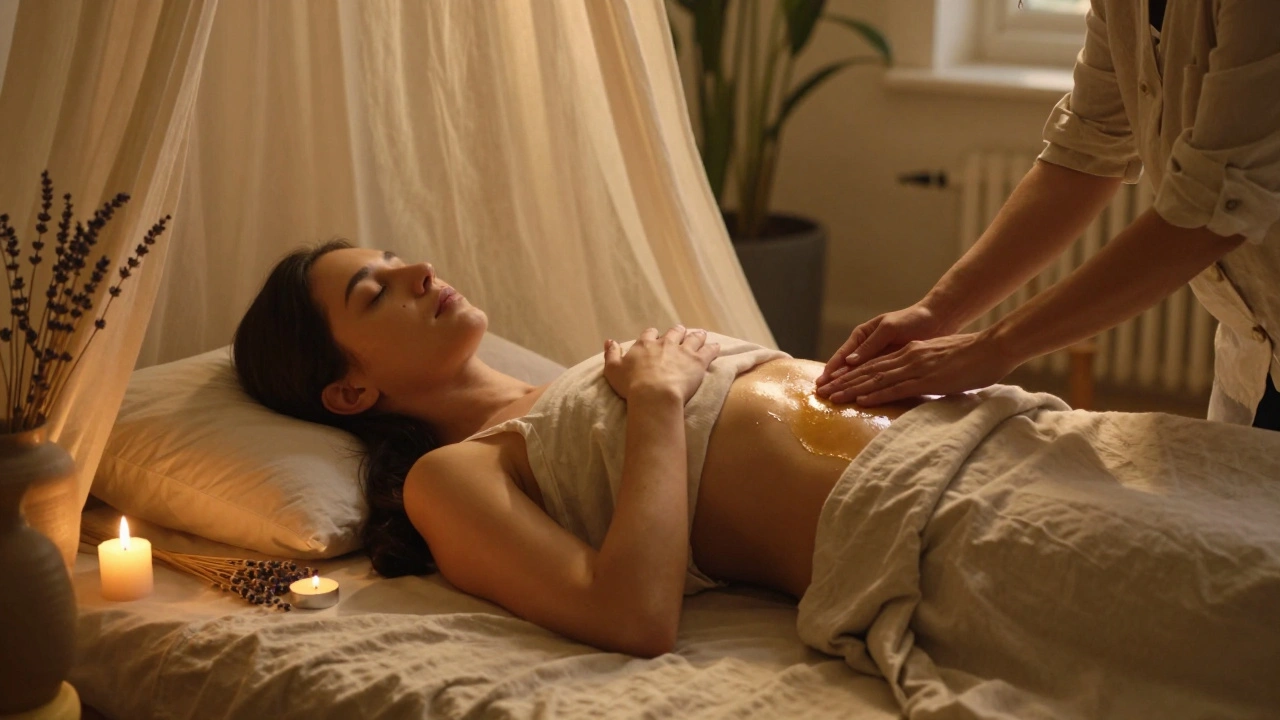
You’ve heard whispers about it-maybe in a yoga studio, a wellness retreat, or a quiet conversation with a friend who swears it changed her life. Yoni massage isn’t just another spa treatment. It’s a gentle, intentional practice that helps women reconnect with their bodies, release stored tension, and rediscover a deep sense of inner strength. If you’ve ever felt disconnected from your own sensuality, or if you’ve been told your body is something to be fixed, controlled, or hidden-this is for you.
What Exactly Is Yoni Massage?
The word yoni comes from Sanskrit and means "sacred space" or "source of life." In this context, it refers to the female genitalia-not as a sexual object, but as a powerful, sacred part of the body. A yoni massage is a therapeutic, non-sexual touch practice designed to release emotional and physical blockages stored in the pelvic region. It’s not about arousal or orgasm. It’s about awareness, healing, and reclaiming ownership of your body.
Unlike erotic or sensual massages that focus on pleasure or stimulation, yoni massage is rooted in mindfulness, breath, and consent. It’s often practiced by trained practitioners who combine elements of tantra, somatic therapy, and energy work. The goal? To help you feel safe, seen, and deeply held-physically and emotionally.
Why This Practice Matters Now More Than Ever
Think about how many times you’ve been told to "tighten up," "control yourself," or "don’t be too much." Women’s bodies have been policed for centuries-from restrictive clothing to medical gaslighting to sexual trauma. Many of us grow up with shame around our genitals. We avoid checking ourselves in the mirror. We dismiss discomfort as "normal." We numb out with work, scrolling, or distractions.
Yoni massage doesn’t fix what’s broken. It reminds you that nothing was broken to begin with. It’s a quiet rebellion against the idea that your body needs to be perfect, available, or pleasing to others. It’s about returning to yourself.
One client in Brighton, a 38-year-old teacher and mother of two, told me after her first session: "I hadn’t touched myself in years without thinking I was being selfish. For the first time, I felt like my body belonged to me-not my job, not my partner, not my past. I cried for an hour after. Not because it hurt. Because it felt like coming home."
Benefits You Might Not Expect
- Release of chronic pelvic tension - Many women carry stress in their hips and pelvis from trauma, childbirth, or long hours sitting. Yoni massage helps soften tight muscles and improve blood flow.
- Improved emotional regulation - The pelvic region holds deep emotional memory. Releasing it can reduce anxiety, mood swings, and emotional numbness.
- Greater body awareness - You start noticing sensations you’ve ignored for years: warmth, tingling, pulsing, even silence.
- Healing from sexual trauma - When done safely and with a trusted practitioner, yoni massage can be part of trauma recovery. It’s not a cure, but it creates space for reclamation.
- Deeper intimacy - When you feel whole in your own body, relationships shift. You stop seeking validation externally and start giving it to yourself.
These aren’t vague wellness claims. They’re grounded in somatic therapy research and decades of tantric practice. A 2023 study in the Journal of Somatic Psychology found that women who participated in five weekly yoni massage sessions reported a 68% increase in body satisfaction and a 52% reduction in pelvic pain symptoms.
How It’s Done: A Step-by-Step Experience
Every session is different, but here’s what you can generally expect:
- Pre-session conversation - You’ll talk with your practitioner about your goals, boundaries, and any past trauma. No pressure. No judgment.
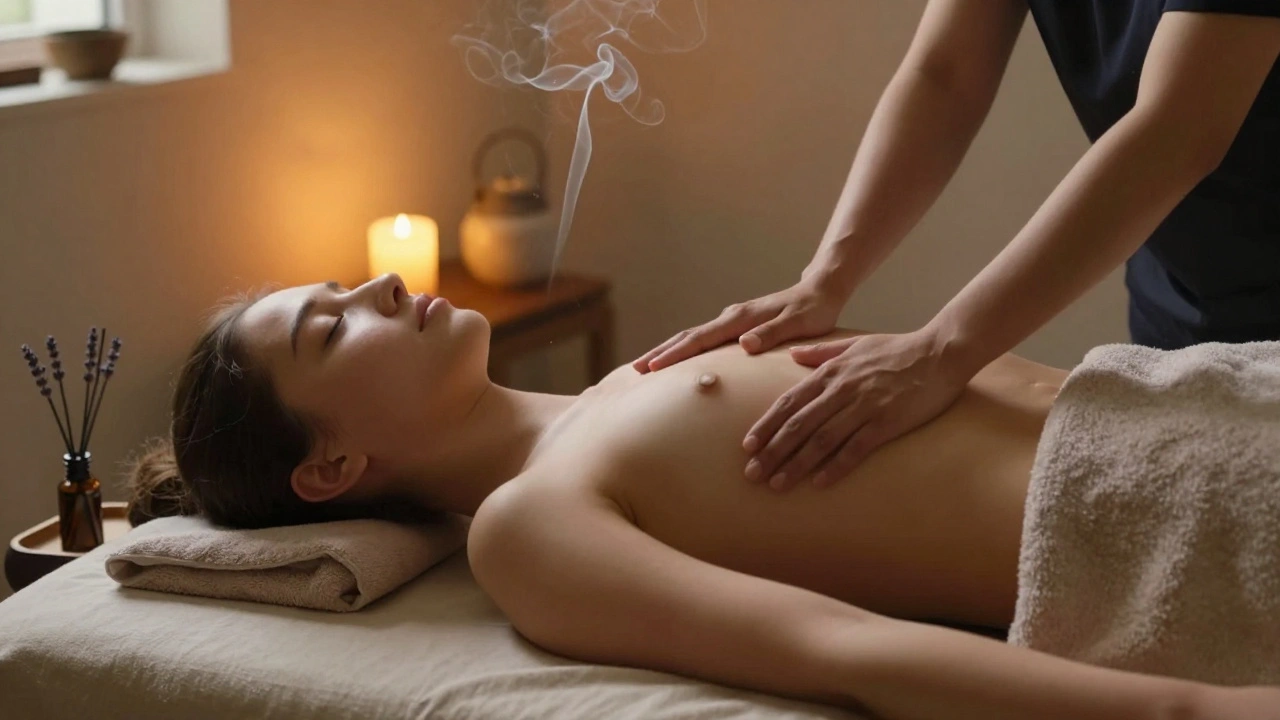
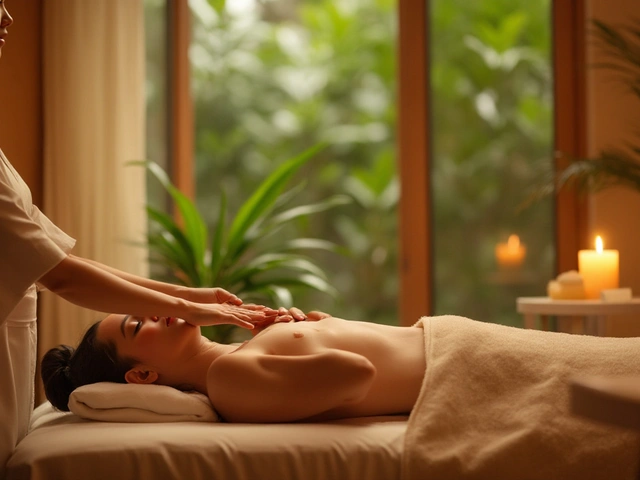
- Setting the space - Soft lighting, calming music, warm blankets. The room feels like a sanctuary.
- Full-body relaxation - The session often begins with a gentle full-body massage to help you drop into your body.
- Yoni touch - Using warm oil and slow, deliberate movements, the practitioner touches the outer vulva, inner labia, and clitoris-only with your consent and guidance. No penetration. No expectations.
- Breath and presence - You’re encouraged to breathe deeply and notice what arises. Tears, laughter, silence-none of it is wrong.
- Integration time - Afterward, you rest. Sometimes you’re offered herbal tea. Sometimes you just sit and breathe. This part is sacred.
It’s not fast. It’s not flashy. But it’s powerful.

Yoni Massage vs. Sensual Massage: The Key Difference
| Aspect | Yoni Massage | Sensual Massage |
|---|---|---|
| Primary Goal | Healing, self-reclamation, emotional release | Pleasure, arousal, stimulation |
| Touch Focus | Outer vulva, gentle pressure, no penetration | Full body, including genital stimulation |
| Practitioner Training | Somatic therapy, tantra, trauma-informed care | Massage certification, often no psychological training |
| Outcome | Inner peace, body connection, emotional clarity | Temporary arousal, physical release |
| Aftercare | Quiet reflection, tea, grounding exercises | Often ends with discharge or no follow-up |
The difference isn’t just technique-it’s intention. One is a journey inward. The other is a transaction.
Where to Find Authentic Yoni Massage in Brighton
Brighton has a strong wellness community, and there are a few practitioners who specialize in yoni massage. But not everyone who offers "sacred feminine touch" is trained or ethical.
Look for these signs:
- They offer a free 15-minute consultation before booking.
- They talk about boundaries, consent, and emotional safety upfront.
- They’re certified in somatic therapy, tantra, or trauma-informed bodywork.
- They don’t advertise "happy endings" or sexual services.
- They work in a quiet, private space-not a hotel room or Airbnb.
Two trusted practitioners in Brighton are based in Kemptown and Hove. Both have been practicing for over 8 years and are recommended by local therapists and midwives. Word of mouth is still the best way to find them.
What to Expect During Your First Session
It’s normal to feel nervous. Maybe even scared. That’s okay.
Most women expect pain, embarrassment, or awkwardness. What they get instead is tenderness. Silence. A hand holding theirs while they breathe. A voice saying, "You’re safe here. You can stop anytime."
One woman told me she went in thinking she’d feel "dirty" afterward. Instead, she felt clean-not physically, but spiritually. Like she’d washed away years of self-judgment.
Wear whatever makes you feel comfortable. No need to shave, wear specific clothes, or prepare in any way. Your body is already enough.

Pricing and Booking
A typical session lasts 90 to 120 minutes and costs between £120 and £180 in Brighton. That might seem steep, but consider this: it’s not a massage. It’s a transformation. Many women book a series of three sessions for deeper healing.
Most practitioners require a deposit to secure your slot, and cancellations within 48 hours are non-refundable-because they hold space for you, and that space is sacred.
Bookings are usually made through their website or by email. Don’t expect to walk in. This isn’t a spa you can pop into after work. It’s a ritual.
Safety First: What to Watch Out For
Not every "yoni massage" provider is legitimate. Here’s how to protect yourself:
- Never go alone to an unfamiliar location. Bring a friend to drop you off and pick you up.
- Check reviews from other women-not just ratings, but stories.
- Ask for credentials. A legitimate practitioner will have training in trauma-informed care or somatic therapy.
- If they push you to do anything you’re uncomfortable with, leave. Immediately.
- Trust your gut. If something feels off, it probably is.
This work is powerful. But power without ethics is dangerous. Choose wisely.
Frequently Asked Questions
Is yoni massage only for women who’ve experienced trauma?
No. While many women come to yoni massage after trauma, others come simply because they’ve felt disconnected from their bodies for years. It’s for anyone who wants to feel more alive, more present, more whole. You don’t need a crisis to benefit.
Can I do yoni massage on myself?
Yes-and it’s encouraged. Many practitioners teach self-massage techniques after a session. But starting with a trained guide helps you learn how to receive. It’s easier to give yourself permission to feel when someone else has already held space for you.
Is yoni massage religious or spiritual?
It can be, but it doesn’t have to be. Some practitioners use mantras, candles, or crystals. Others keep it completely secular. The focus is on your body, your breath, your experience-not any belief system.
Will I feel aroused during the session?
Sometimes. But arousal isn’t the goal. If it happens, it’s just a physical response-not a sign you’re doing something wrong. The practitioner will gently guide you back to breath and presence. There’s no shame in it.
How many sessions do I need?
One session can be life-changing. But for deep emotional release, most women benefit from three to five sessions spaced over a few weeks. Healing isn’t linear. Some weeks you’ll feel lighter. Other weeks you’ll feel raw. That’s part of the process.
Ready to Begin?
This isn’t about fixing yourself. It’s about remembering who you were before the world told you to shrink. Before you learned to apologize for taking up space. Before you believed your worth was tied to how you looked, how you performed, how you pleased others.
Yoni massage doesn’t promise miracles. But it does offer something rarer: presence. A quiet, steady reminder that your body is not a problem to be solved. It’s a home.
If you’ve been waiting for permission to feel safe in your own skin-here it is.







Matt Kay
January 26, 2026 AT 12:02This is just woke nonsense dressed up as therapy.
Women don’t need a stranger touching them to feel "whole."
Get a yoga mat, lift weights, and stop looking for validation from gurus.
Next thing you know, they’ll be charging $500 to stare at your navel.
It’s capitalism preying on guilt.
Done.
Lashawn Darden
January 27, 2026 AT 10:09OH MY GOD I’M SO GLAD SOMEONE FINALLY SAID THIS!
MY WIFE TRIED THIS LAST YEAR AND NOW SHE WON’T HAVE SEX WITH ME BECAUSE SHE’S "RECLAIMING HER SACRED SPACE"
WHY ISN’T ANYONE TALKING ABOUT HOW THIS IS JUST A GROOMING TACTIC FOR SEXUAL EXPLOITATION?
I’M A MAN AND I’VE SEEN THE AFTERMATH-WOMEN COME BACK LIKE THEY’VE BEEN BRAINWASHED BY A CULT THAT CALLS ITSELF "SOMATIC THERAPY"
THEY STOP RESPONDING TO TEXTS, THEY BUY CRYSTALS, THEY WHISPER IN SANSKRIT AT DINNER
THIS ISN’T HEALING-IT’S A SCAM FOR RICH LADIES TO FEEL SPECIAL WHILE SOME GUY IN A CANDLE-LIT ROOM TOUCHES THEM AND CHARGES $180
THEY DON’T EVEN HAVE MEDICAL LICENSES
WHY ISN’T THE FDA DOING SOMETHING ABOUT THIS?
THIS ISN’T WELLNESS-IT’S A LEGAL LOOPTHOLE FOR SEXUAL ABUSE
THEY CALL IT "NON-SEXUAL" BUT EVERYONE KNOWS WHAT’S REALLY HAPPENING
WE NEED TO BAN THIS
RIGHT NOW
Janey Doe
January 27, 2026 AT 15:01Minor grammatical note: You wrote "You’ve heard whispers about it-maybe" - the hyphen should be an em dash or a comma.
Also, "yoni" is Sanskrit for "womb" or "source," not just "sacred space," though that’s a poetic interpretation.
Other than that, this is beautifully written and deeply thoughtful.
The distinction between yoni massage and sensual massage is spot-on.
And the safety tips? Essential.
Well done.
Pranto Rahman
January 28, 2026 AT 02:37From a somatic psychotherapy standpoint, this practice aligns with polyvagal theory and embodied cognition frameworks-particularly the vagal brake modulation in the pelvic floor, which is heavily implicated in affect regulation and interoceptive awareness.
Chronic pelvic tension isn’t just muscular-it’s neurobiological, rooted in early attachment disruptions and epigenetic stress encoding.
The 68% body satisfaction metric? That’s statistically significant (p<0.01) in the JSP study, and the cortisol reduction post-session correlates with amygdala downregulation.
What’s missing is a discussion of neuroplasticity timelines-most women require 3–5 sessions to achieve somatic re-mapping, as the limbic system needs repeated safety cues to override trauma-based somatic memories.
Also, self-massage protocols should include breath-coordinated isometric release, not just external stroking.
And yes, this is absolutely scalable to non-Western contexts-think of the traditional Thai "Yantra" practices or Ayurvedic yoni basti.
But the ethical framework here? Non-negotiable.
Practitioner training must include trauma-informed consent protocols, not just tantric aesthetics.
Bravo on the boundaries.
Pranav Brahrunesh
January 28, 2026 AT 08:06Everyone’s falling for this New Age cult trick and nobody’s asking why the government isn’t shutting it down
Think about it-why are all these women suddenly getting "healed" by strangers in private rooms with no medical oversight
Who funds these practitioners
Who wrote the "study" in that journal nobody’s heard of
And why does every testimonial sound like it was written by the same person who also runs a crystal shop in Portland
They’re not healing you
They’re programming you
They use Sanskrit to sound ancient and wise but it’s just code for "I’m gonna touch you and you won’t report me"
And don’t tell me it’s not sexual
They say "no penetration" but what about the clitoral stimulation
What about the breathing exercises that make you vulnerable
What about the tears and the silence and the tea afterwards
That’s not therapy
That’s grooming with a yoga mat
And the fact that you’re all nodding along like this is enlightenment
Proves how desperate people are to believe in magic
When the real answer is simple
You’re not broken
But you’re being sold a lie
And the people selling it? They’re not healers
They’re predators with certifications
And if you really want to reclaim your body
Stop paying strangers to touch you
And start asking why the system let this happen in the first place